
| Thème pastoral 2009 The path of Bernadette
|
The year 2008 was obviously devoted to the apparitions. We have not forgotten Bernadette, since the path of the Jubilee passed by three significant places: the baptismal font, the Cachot and the oratory of the Hospice. But the path to the Jubilee stopped on July 16, 1858, the day of the last apparition.
I propose this year to pursue the way of Bernadette, because Bernadette lived twenty-one years after the apparitions: eight years in Lourdes and thirteen years in Nevers. The Church has declared her a Saint but not by virtue of the apparitions (all visionaries of history have not been canonized), but because of her entire life.
To end the story of Bernadette in 1858 would be as absurd as stopping the story of the Virgin Mary at the Annunciation. As Mary has continued her pilgrimage of faith, in the words of Pope John Paul II, Bernadette continued her journey with courage. That is why, after the Way of the Jubilee, we offer the Way of Bernadette.
It is not to be read in the detail of the biography of Bernadette but to find four components of her Christian life which, in one way or another, the 21st century as the 19th for the laity as for religious, can be found in any Christian life.
However, it will be good for animators, to know well the life of Bernadette: see the selection of publications (books, comics, magazines, CDs, DVDs) below. It will be easy every day, to make a presentation of relevant questions to pilgrims from the life of Bernadette.
The order of four themes is at the discretion of leaders.
I) Discerning her vocation
Symbolic Place: the Hospice
 Oratory of the hospice |
|
Bernadette knew from an early age that she would be a religious. She never wanted to settle in the world, as she saw it. She refused any monetary offers. She turned away the suitors, some of which were serious.
But she has eight years to find out where the Lord was calling her. When the Lady said to her, the first time, go to the spring for drinking and washing, she goes first to the river Gave. The Lady must make it clear that this is the wrong direction. The scene of February 25 includes trial and error before the discovery of the spring. It was the same for the discernment of her vocation. |
Bernadette having seen the Holy Virgin, it perhaps was expected for her to enter a contemplative congregation. Quite naturally, she thought of the Caramel at Bagnères, founded in 1853. But her health does not allow her to follow fully the rule. She refuses any prospect of adapting the rule. So, this type of order, with its austerity, is not for her. She must look elsewhere.
The books tell you
- Attempts by various congregations to attract Bernadette;
- Dialogue with Bishop Forcade, bishop of Nevers in 1863, after which her response is to think seriously on what was discussed.
- Obstacles to overcome (no dowry, bad health, commitment to her family);
- The reluctance of the Sisters;
- The patience of her confessor, Father Pomian, chaplain at the Hospice;
- Learning how to serve the sick
- Finally, her option for the congregation of «Sisters of Charity and the Christian instruction Nevers,» a attraction for the service of the poor and because the sisters did not seek to influence it.
Questions of the day :
- How to discern God’s will?
- What does «Thy will be done» mean?
- How to discern a priestly or religious vocation? - How are we encouraged?
II) Life in Church
Symbolic Place: the rectory and the church
 The rectory |
|
Bernadette was not able, for various reasons to attend catechism: we know why. But she did not live outside the Church. She was baptised at the age of two days. She attended church, went to Mass not only on Sunday but on some weekdays. On Sundays, she also went to vespers: February 14, 1858, her mother does not want her to return to the Grotto, among other reasons because she may not get back in time for vespers. The vespers were, of course, in Latin. Please note that if they were sung in French, it would not have changed since Bernadette did not know French. |
Her church is also her family, «a small domestic church», as was recently reiterated by Pope Benedict XVI. In the Soubirous family, parents and children recite the rosary together. They are mutually supportive. They endure all the blows of life and learn trust. «Where two or three are gathered in my name…»
The Church is very present in the period of the apparitions since Bernadette asked several times for advice from Fr. Pomian and, above all, because she is entrusted with a mission to «priests». The purpose of the mission itself is ecclesial: a procession and a chapel. Despite the poor reception from Fr. Peyramale, Bernadette returned to the presbytery. At the request of Fr. Peyramale, she asked the Lady what her name was who finally told her: «I am the Immaculate Conception. » She did not understand what this meant but it corresponds with the dogma proclaimed by Pope Pius IX in 1854.
Let us not believe, however, that Bernadette has been hoodwinked by the clergy who used many means to catch her out. She also stood up to them when perhaps they tried to use the situation for their own purposes. She would prefer that they remain in their dioceses rather than coming to disturb. Bernadette does not confuse missions. She was responsible for delivering a message: it was transmitted. But she does not feel superior to priests: she refuses to bless objects.
Saint Paul received an extraordinary grace on the road to Damascus: he became a Christian, as does everyone, by baptism. Bernadette enjoyed extraordinary graces, but she continued to prepare for her First Holy Communion and she was quite happy when she was able to enter the group, the Children of Mary.
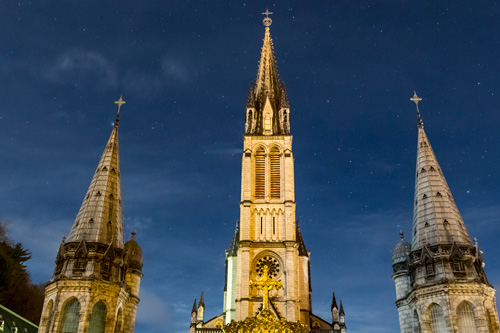
 The church |
|
Her membership of the Church will take a particular form when she becomes a Religious. Obedience, in particular, meant a very different way of living, especially if you compare a nun of the 19th century and a lay woman of the 21st century. But we should not reduce the life of Bernadette in Nevers to the reports, sometimes tense, with her superior. Every day, Bernadette shared with other Sisters the same desire to love Christ and her neighbour. She tried to help other sisters, when they were in pain or trouble.
Her vision of the Church went beyond her religious community: Bernadette had a keen sense of the communion of saints: or rather communion with sinners. She implemented throughout her life, the request of the Lady: «Pray to God for sinners. »She offered all her sacrifice and suffering for all sinners. In her sleepless nights, she felt united to the Masses celebrated in the early hours of the morning in other lands. |
Questions of the day :
- What are our strongest experiences, positive or negative, of "Church life" ?
- We often speak of «the parish community »: can a parish be a community?
- "Adhere to the Church": do these words have meaning for you?
III) The Eucharist
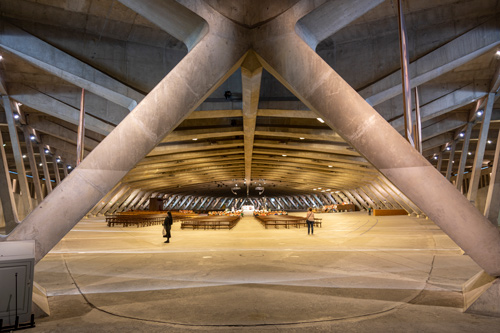
Symbolic Place: the tent of adoration
The Eucharist is linked to the apparitions, at least chronologically. Bernadette returned from Bartrès in January 1858 to prepare, finally, for her First Holy Communion. It took place on June 3, the day of Corpus Christi, in the oratory of the Hospice. That is why the Jubilee Way ended here.
In addition to the coincidence of dates, it is possible to see a logical connection between apparitions and the Eucharist: Mary prepared Bernadette to receive her Son. Mary gave her Son to Bernadette. In doing so, she began to realize the promise of February 18: Bernadette would be happy, not in this world, but in the other. The Eucharist is the foretaste of that other world.
At a time when communion was rare, Bernadette obtained from her confessor permission to receive Communion three times a week. At Nevers, she was a frequent communicant. Her sisters in community testify to the beauty of Bernadette’s face after receiving Holy Communion, her act of thanksgiving could last a long time without a break.
Bernadette was far more nourished by the Eucharist than by memories of the Grotto. Through the Eucharist, she found the Virgin as we receive the risen body of the One who is born of the Virgin Mary: Ave verum corpus natum de Maria Virgine.
The tent of adoration
Anyone who would like to meditate on the link between Mary and the Eucharist might read in the encyclical of Pope John Paul II on the Eucharist, the chapter that refers to Mary as «Woman of the Eucharist.»
During her long and frequent stays in the infirmary in Nevers, Bernadette suffered and was unable to attend Mass. When she could, she participated with all her heart, uniting the offering of her life and suffering to the offering of Christ.
At the hospital, her bed was surrounded by white curtains. She called this place the «white chapel.» The Virgin had sent her to the priests to build a chapel. At the time of her death in 1879, the Basilica of the Immaculate Conception was inaugurated and plans for a larger basilica were unveiled, the Rosary basilica. But the real buildings are the temples of prayer grounded in Christ, built on the Holy Spirit.
In the last hours of her earthly life, Bernadette is compared with a grain of wheat, similar to those she had seen the ground at the Boly mill. It reproduced in her the vocation of the Suffering Servant: «Crushed by suffering, it pleased the Lord. She also knew that the seeds needed to be ground to become Bread of Life.
Questions of the day :
- Holy Communion has become «frequent» since the time of St. Pope Pius X: for this reason, the underground basilica was dedicated in his name.
- How does the frequent reception of Holy Communion not become a right or something that is automatic?
- Do we still value and treasure the Eucharistic Prayer?
- Practically speaking what can we do to help the younger generations to discover Eucharistic adoration?
- How do we live in Lourdes, the Eucharistic time of the afternoon: procession / worship / blessing?
IV) Service
Symbolic Places: the Accueils, the City Saint-Pierre
On Holy Thursday, in the liturgy, Jesus established the Eucharist and washed the feet of his disciples. In both cases, he told them to do as he had shown them. «Do this in remembrance of me. » It’s an example that I have given you so that you do, as I did for you.
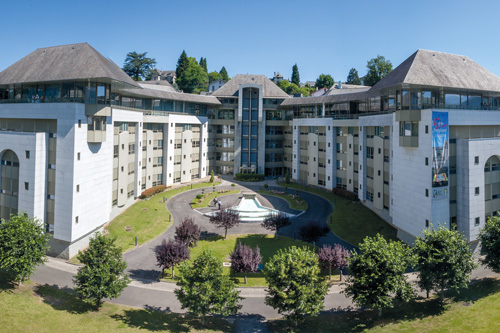
 The Accueil Notre-Dame |
|
 The City Saint-Pierre |
At the Hospice of the Sisters of Nevers, Bernadette, at the same time, engaged in a Eucharistic spirituality and began to serve the sick. To tell the truth, the service was, in her home, a standard rule, either as part of the family, the cabaret run by her aunt or Bartrès. But with the sick, aged, bedridden and miserable in the mid-19th century, the service took was less poetic than looking after sheep.
It is also true that Bernadette has an inner strength, in a fragile body, and had experienced the difficulties and an underside of life. But her love for the poor did not only have natural qualities. Like all saints, she loved Christ suffering in his members. Even if their charisma is not particularly a care for the sick, there are few saints who have not shown a tender love and effective care for patients. Think of St. Ignatius of Loyola or Frederic Ozanam. In the Gospels, the most numerous around Jesus are the sick and the disabled.
Bernadette has overcome her revulsion at certain illnesses, a love of Christ. It gave courage to the other Sisters to overcome their fear and hesitance before face of sickness. From being merely a help nurse who was simply to serve tea, she became the head of the infirmary in Nevers and the doctor who visited the convent gave an account in testimony of esteem and confidence in this Sister whom some thought was crazy.
 The Accueil Saint-Frai |
|
By her inner joy, by her common sense, by her spiritual insight, her humility, by the example of her prayer, Bernadette rendered service to the community, without even realizing it, which she likened to a broom that rested on the range once the household work was completed.
The hardest part for Bernadette was to surrender. She went to and remained in the Congregation’s house in Nevers for treating the poorest: Her superiors thought it would be imprudent to allow her to leave Nevers. She also had to renounce serving her sisters as a nurse and to accept service from others. Bernadette was humble, but proud: having to learn to be dependent was difficult to accept.
How not to think of Pope John Paul II who in the last days of his pontificate, thought that the greatest service it could render to the Church was to offer his suffering, in union with Christ our Saviour? |
Questions of the day :
- What kind of service we can render? In our community? In the Church? In society?
- This question can also be addressed about the Christian communities to which we belong and our parishes: What is the service that the Lord expects?
- That Christ is present in our brothers and sisters in their sickness and distress. It is also good to remember that unfortunate times cross all our paths.
- Do we pray by the service we offer to others?
|